A student graduation speech is usually 3–5 minutes long, or about 420–700 words at a natural speaking pace. That's not a rule of thumb — it's what universities actually ask for. Of the five student-speaker guidelines below, every one sets a limit between three and five minutes, and four of them also give a word count.
The word counts are the interesting part, because they don't all assume the same speed. Divide the words by the minutes and some universities expect you to speak well above ReadCalc's 140 words per minute baseline. If you write to the word limit and speak at an ordinary pace, you can run over the time limit without ever going over the word count.
What Universities Actually Ask For
These are the published limits for student commencement speakers at five US universities. The implied pace is ReadCalc's calculation: the university's words divided by its minutes.
| University | Time limit | Word guidance | Implied pace |
|---|---|---|---|
| Stevens Institute of Technology | Under 3 min | — | — |
| Idaho State University | 3–4 min | ~400–500 words | ~125–133 WPM |
| Grand Canyon University | 3–5 min | ~400–650 words | ~130–133 WPM |
| UCLA College ← | 4 min or less | 625 words max | ~156 WPM |
| Indiana University Bloomington | 3–5 min | ~500–750 words | ~150–167 WPM |
Idaho State and Grand Canyon assume a pace close to the 130–160 WPM range for prepared speech. UCLA and Indiana assume something faster. UCLA's rule is the clearest example: 625 words at most, delivered in four minutes or less at the audition. That only works at about 156 WPM. At 140, 625 words takes around 4 minutes 28 seconds.
If your university gives a time and a word count, write to whichever is smaller at your pace. At 140 WPM, four minutes is 560 words, so a 625-word cap isn't your real limit — 560 is. UCLA itself notes that successful speeches typically run 550–600 words, under the cap.
Graduation Speech Length in Words
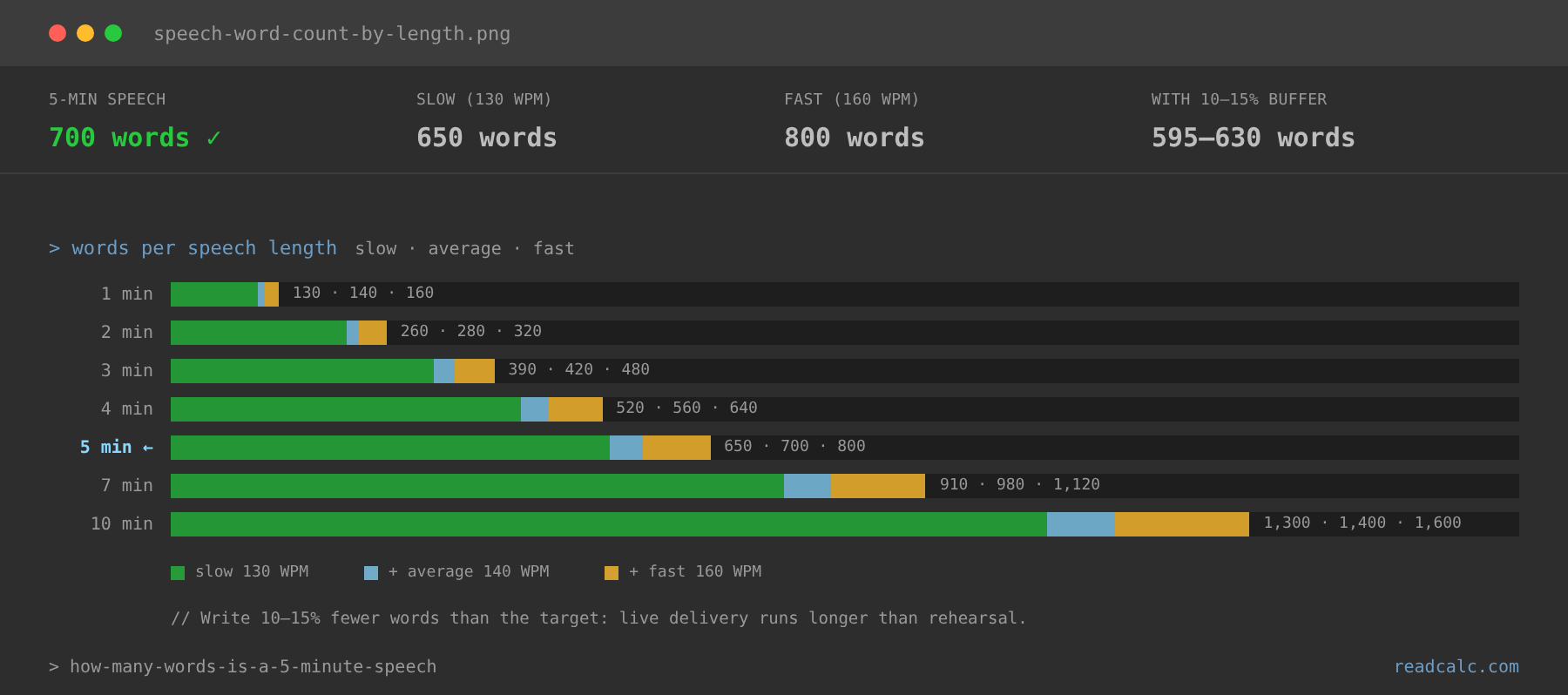
If you've been given a time and nothing else, this is how many words fit. Short isn't a handicap: even TED, with its 18-minute ceiling, says 3–9 minute talks can be just as impactful. The table uses 130 WPM (slow and deliberate), 140 WPM (average) and 160 WPM (fast).
| Duration | Slow (130 WPM) | Average (140 WPM) | Fast (160 WPM) |
|---|---|---|---|
| 2 minutes | ~260 words | ~280 words | ~320 words |
| 3 minutes | ~390 words | ~420 words | ~480 words |
| 4 minutes ← | ~520 words | ~560 words | ~640 words |
| 5 minutes | ~650 words | ~700 words | ~800 words |
Why Graduation Speeches Run Long
Graduation speeches are given in big halls to a crowd of families, and cheering or applause partway through is normal. Every pause it forces comes out of your time limit, and a word count can't see any of it.
You also usually can't rehearse in the room. UCLA's guidelines are specific about what you will have on stage: no teleprompter, and every speaker reads from a prepared binder at the podium — nobody delivers from memory. They also tell auditioning students not to speed-read through the speech to fit the time, which is exactly the temptation when a draft comes in long.
The fix is the same buffer that works for any speech: write 10–15% fewer words than the time allows. For a 4-minute slot that's about 480–500 words. Cut from the thank-yous before you cut from the ending; a list of names is the part an audience forgets first.
The Most Reliable Way to Check
Start with your own pace, not the average. The speech rate test tells you whether you're a 130 or a 160 speaker, and that's the difference between 520 and 640 words in four minutes. Then paste your draft into the script timer to see where each minute falls, and rehearse standing up at performance pace — from paper, if that's what you'll have on the day. The pages-per-speech table shows what four minutes looks like printed: just over two double-spaced pages.
Sources
-
The speech must be no longer than 3 spoken minutes; applicants submit the speech and a video of themselves delivering it.
-
The address should be between 3 and 4 minutes, approximately 400–500 words.
-
Selected speakers prepare a three-to-five-minute speech, approximately 400–650 words.
-
Speeches must be four minutes or less when delivered at the audition and 625 words or fewer, counting every word including the salutation; successful speeches are typically 550–600 words. No teleprompter: speakers read from a binder at the podium.
-
Undergraduate and graduate student speeches are about 3–5 minutes long, or about 500–750 words.
Paste your graduation speech into ReadCalc to see how long it runs out loud.
$ open readcalc.com →