A TED talk is 18 minutes or less. That's TED's own recommendation, and TEDx events work to the same limit. But 18 is a ceiling, not a target: TED says shorter talks of 3–9 minutes can be just as impactful, and its TEDx rules call 3–9 minutes ideal for a focused idea.
In words, a full 18-minute talk is about 2,500 words at ReadCalc's 140 words per minute baseline. TED speakers tend to go faster than that — one analysis put their average at 163 WPM, or nearly 2,950 words in 18 minutes — but that's not the number to write to, for reasons below.
TED Talk Length in Words
The lengths come from TED's guidance. The word counts are ReadCalc's: each length multiplied by 140 WPM (ReadCalc's baseline) and by 163 WPM (the TED-talk average in Andrew Dlugan's analysis).
| Talk length | Where it comes from | Words at 140 WPM | Words at 163 WPM |
|---|---|---|---|
| 5 minutes | Short TED talk | ~700 | ~815 |
| 9 minutes | Top of the 3–9 min "focused idea" range | ~1,260 | ~1,470 |
| 12 minutes | Top of TEDx Studio talk range (6–12 min) | ~1,680 | ~1,955 |
| 18 minutes ← | TED / TEDx maximum | ~2,520 | ~2,935 |
The 18-minute figure isn't arbitrary. TED's guide for TEDx speakers answers "Why 18 minutes?" with "Because it works": an audience is good at focusing on one subject in short chunks. Its answer to "Can I go over 18 minutes?" is just as short: no, or it wouldn't be a TEDx talk. Some formats are allowed to run longer — TED says dialogues between two speakers or dynamic interviews can go up to 30 minutes, and TEDx talks over 18 minutes are reviewed before they're published on the TEDx YouTube channel.
Why TED Speakers Talk Faster
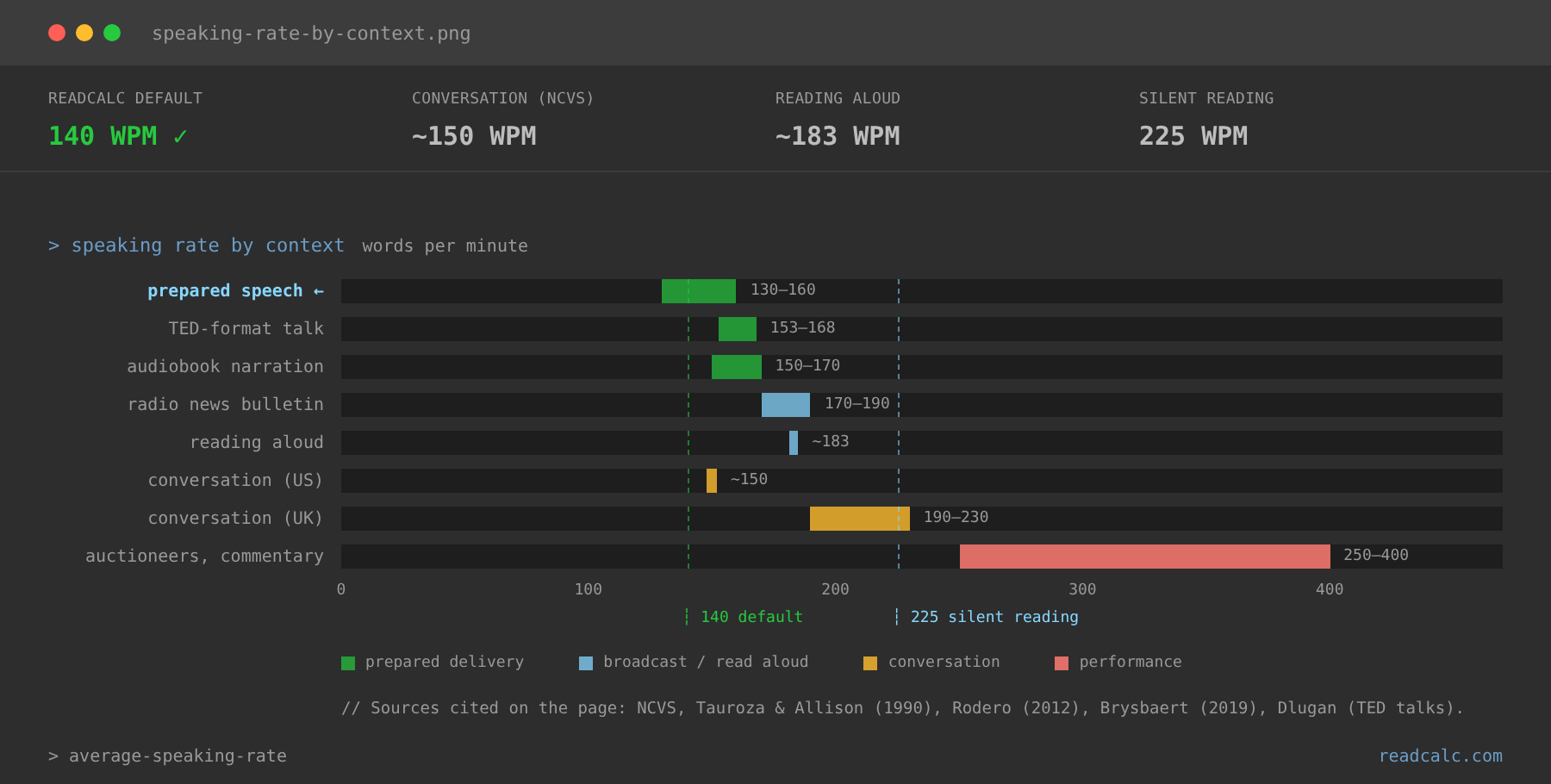
Andrew Dlugan of Six Minutes measured nine TED talks, from just under 7 minutes to just under 20, and found an average of 163 WPM, with two-thirds of them between 153 and 168. The slowest was Al Gore at 133; the fastest was Jacqueline Novogratz at 188. Dlugan's own caution is that the figure is for a narrow speaking situation, not speech in general.
That's why ReadCalc still uses 140. Dlugan's explanation for the speed is preparation: these speakers are extremely well rehearsed, so they rarely make the verbal slips that slow the rest of us down. You write before you've rehearsed. If you write 2,900 words for an 18-minute slot on the assumption you'll speak like a TED veteran, you'll be cutting on the morning. If you write 2,500 and you turn out to be fast, you'll finish at around 15 minutes — and nobody has ever complained about that.
Write to 140 WPM and the length you've been given, then take off 10–15%. For an 18-minute slot that's about 2,150–2,250 words. Use the speech rate test to find your own pace; if you really do speak at 160+, you can add words back after rehearsal, not before.
How Long Should Your TED-Style Talk Be?
If you've been asked for a TEDx talk, ask the organiser for your exact slot before you write anything — 18 minutes is the most you can have, not what you'll be given. TED's guidance points the same way: shorter talks are not lesser talks. TED recommends 6–12 minutes for TEDx Studio talks, which are filmed for online viewers rather than a live audience.
A 10-minute talk is about 1,400 words, and a 5-minute talk about 700. The TED format is built around one idea, so a shorter talk isn't harder to fill — it's usually easier to keep focused. A student graduation speech is shorter again: most universities cap it at 3–5 minutes.
The Most Reliable Way to Check
A talk at this level gets rehearsed many times, so get the timing right early. Start by running the full script through the teleprompter at your measured pace — the teleprompter speed guide covers what speed to set — and then use the script timer to mark where each section should start. Those timestamps are what you'll check against in rehearsal: if you're at the second idea by minute four, you're on track. How to time a script has the full method.
Sources
-
TED recommends talks of 18 minutes or less. Shorter talks of 3–9 minutes can be just as impactful; non-traditional formats such as a dialogue between two speakers or a dynamic interview may run up to 30 minutes.
-
TEDx talks are typically under 18 minutes, with 3–9 minutes ideal for a focused idea. Talks over 18 minutes are reviewed by the TEDx team before publication on the TEDx YouTube channel.
-
Explains the 18-minute limit ("Because it works") and states that a talk over 18 minutes would not be a TEDx talk.
-
Recommends a 6–12 minute duration for Studio talks, which are filmed separately from a live event and optimised for digital viewers.
-
Analysis of nine TED talks from just under 7 to just under 20 minutes: average 163 WPM, two-thirds between 153 and 168 WPM, ranging from 133 (Al Gore) to 188 (Jacqueline Novogratz).
Paste your talk and see where every minute falls — at 140 WPM or your own pace.
$ open script-timer →